Online training
If you feel unsure or have any questions before operating the system, please contact us or seek help in the area of the station.
The person responsible for the filling site is obliged to instruct and train all persons authorised to use the system. This training must be renewed annually and recorded in the so-called compressor log. In addition, every fill must be recorded in the compressor log – our system automatically records and logs fills and the operator.
Access requirements: to fill, you need an account, completed training and sufficient credit. Filling is only permitted from the age of 18.
The most important point of the training – the (TÜV) certificate
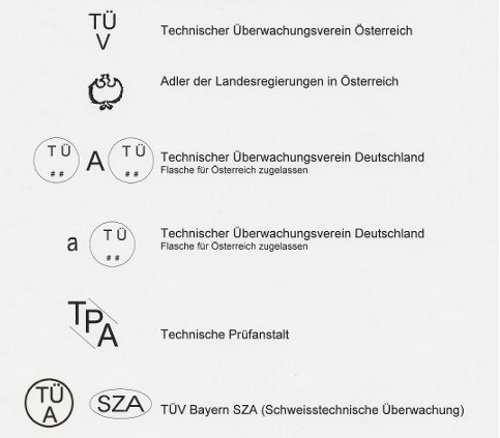
For safety reasons, only compressed air containers whose inspection date has not expired may be filled (see the date on the inspection stamp of the last periodic inspection, e.g. TÜV, TPA, KKS, ÜTW, SZA).
Markings such as “CE xxxx” or “π” confirm conformity at the time of manufacture and are not periodic inspection stamps – what counts is always the date of the last periodic inspection.
The inspection intervals differ depending on the country (AT/DE/CH), tank type (steel/aluminium/composite) and type of inspection. Find out about the national regulations that apply to you. Our help page Checking your tank inspection (TÜV) shows you what a valid inspection stamp looks like and how to recognise it. If in doubt: don’t fill.
Tanks must have a residual pressure of at least 10 bar to be filled. Below 10 bar, filling with our system is not possible – sufficient residual pressure is essential to prevent moisture and dirt from getting into the tank (risk of corrosion).
Our stations fill to a maximum of 225 bar and are protected against overpressure by a tested safety valve. You are responsible for knowing the maximum working pressure stamped on your tank (e.g. 200/232/300 bar) and for not exceeding it. If your tank’s permitted pressure is below 225 bar, end the fill yourself in good time: tap “Stop” and close your tank valve immediately – only closing the valve reliably ends the fill at all stations.
If the tank pressure drops too far, moisture can get into the tank (risk of corrosion) – so always maintain the residual pressure. If a tank is completely empty, it should be checked for moisture by a qualified person and dried if necessary. A separate issue is regulator freezing while diving, which can only be prevented by dry breathing air in accordance with DIN EN 12021 – that’s why our stations fill only air of this kind.
In most cases, inspection and/or TÜV stamps look different. The following picture shows some well-known examples:
Filling sequence
Before filling:
- The first step is to check the inspection stamp and the valid inspection date (a missing or illegible inspection stamp must be treated as an expired inspection date).
- Before starting, you must actively confirm in the system that the tank’s inspection date is valid. Under “My tanks”, you can save your tanks with the expiry date of their inspection – tanks with an expired inspection date are then blocked.
- The station is used on a “first come, first served” basis. If it’s busy, keep the page open – it switches to “Start now” automatically as soon as the station is free. There is no waiting list.
- The filling system must be checked for damage and for unusual sounds of flowing air. Anyone who starts a system that appears to be damaged is acting with gross negligence.
- The pressure vessel must be connected in accordance with the requirements. Only DIN connections are available at our stations. Adapters other than DIN-INT adapters are not permitted. Tested DIN-INT adapters are tolerated but not recommended – you are responsible for the suitability and inspection status of the adapter yourself; we accept no responsibility for operability with additional equipment.
During filling
- Stay with your tank for the entire fill and keep an eye on the fill pressure – even if your phone screen switches off, the fill continues. In the event of any kind of problem, press the red emergency stop button and report the problem.
- If your tank’s permitted pressure is below 225 bar, end the fill yourself in good time: tap “Stop” and close your tank valve immediately – only closing the valve reliably ends the fill at all stations.
After filling
- The pressure must be checked again before using the tank.
You’ll find more information on the detailed filling process in the filling instructions.
This training is not a general basic filling instruction and only applies to use at filling stations in the DiveAir network. Smoking in the filling area is strictly prohibited. Please also try to avoid unnecessary noise.
All our partners guarantee that only air in accordance with DIN EN 12021 is supplied. All compressors have a moisture shutdown.
Home page